

The research group has made significant progress in the field of spatially resolved detection in the mid-infrared.
Recently, the research group has made significant progress in the field of mid-infrared spatial resolution detection. The related research results were published online in the journal ACS Photonics on September 11, 2025, under the title "Angle-resolved mid-infrared detection based on noncollinear configuration". Doctoral students Liu Ning and Wang Xuewen are the co-first authors of the paper, Professors Yuan Jinpeng and Wang Lirong are the co-corresponding authors, and Professors Xiao Liantuan and Jia Suotang provided important guidance for this work.
Mid-infrared detection holds broad application prospects in frontier fields such as environmental monitoring, remote sensing, free-space communication, and national defense security. Particularly, the research area of achieving target identification, location, and tracking through high-precision spatial analysis is of critical importance. Most existing measurement techniques rely on geometric optical principles and employ optical devices with relatively complex structures, which have certain limitations in system integration and flexible operation, especially showing obvious insufficiency in compatibility with the mid-infrared band. With the increasing demand for high sensitivity, high precision, and high stability in mid-infrared detection, how to achieve efficient detection and high-precision analysis of the spatial information of mid-infrared signals has become an important scientific issue that urgently needs to be addressed in the field of spatial optics. In recent years, a method for efficiently analyzing mid-infrared signals based on spectral migration detection technology through nonlinear frequency conversion has been developed. This method effectively compensates for the limitations of direct measurement methods by taking advantage of the spatial angle selection characteristics of the phase-matching mechanism. Compared with nonlinear crystals, alkali metal atoms, as a pure and uncontaminated nonlinear medium, have advantages such as high quantum efficiency, rich energy levels, and wide frequency tuning range, making them an ideal experimental platform for mid-infrared signal analysis. The multi-wave mixing technology in a non-collinear configuration not only accurately maps the mid-infrared spatial information to the visible light band but also has a self-calibration mechanism, significantly enhancing the stability of system measurement. Therefore, the nonlinear frequency conversion technology based on atomic media provides a feasible solution to break through the bottleneck problem of high-precision spatial resolution in mid-infrared detection.
The research group proposed and experimentally verified a mid-infrared spatial resolution detection technology based on atomic spectral migration. The research team utilized the principle of spectral migration detection and non-coincident phase matching to successfully map the spatial information of the mid-infrared band to the visible light band and achieve the trajectory inversion and tracking of mid-infrared targets by analyzing the visible light signals. This experimental system not only achieved the mapping of spatial information from the mid-infrared band to the visible light band but also had a stable internal self-calibration function. This breakthrough opened up a new technical path for high-precision analysis of mid-infrared spatial information. The research team constructed a mid-infrared spatial resolution measurement system based on non-coincident phase matching using the diamond-type energy levels of 85Rb atoms 5S1/2 - 5P3/2 - 5D5/2 - 6P3/2. The mid-infrared spatial information of the target was successfully mapped to the visible light band. Based on the vector relationship of all participating beams in the system, the centroid extraction algorithm was used to analyze the spatial position of the signal beam in the projection plane, thereby inverting the azimuth and elevation angles of the mid-infrared beam of the target, and successfully verifying the effectiveness and stability of the measurement system through long-term real-time measurement. Finally, the azimuth and elevation angles of some mid-infrared target beams and signal beams were quantitatively analyzed, and they showed an approximately linear dependence relationship, with the proportion factor approximately equal to λ420/λ5233 ≈ 0.08. Taking into account the mechanical errors, refraction effects and resolution limitations of the experimental system, this system can achieve an absolute error of less than 0.76′, and an instability of less than 0.12′ in space resolution within a continuous 4.5-hour period.
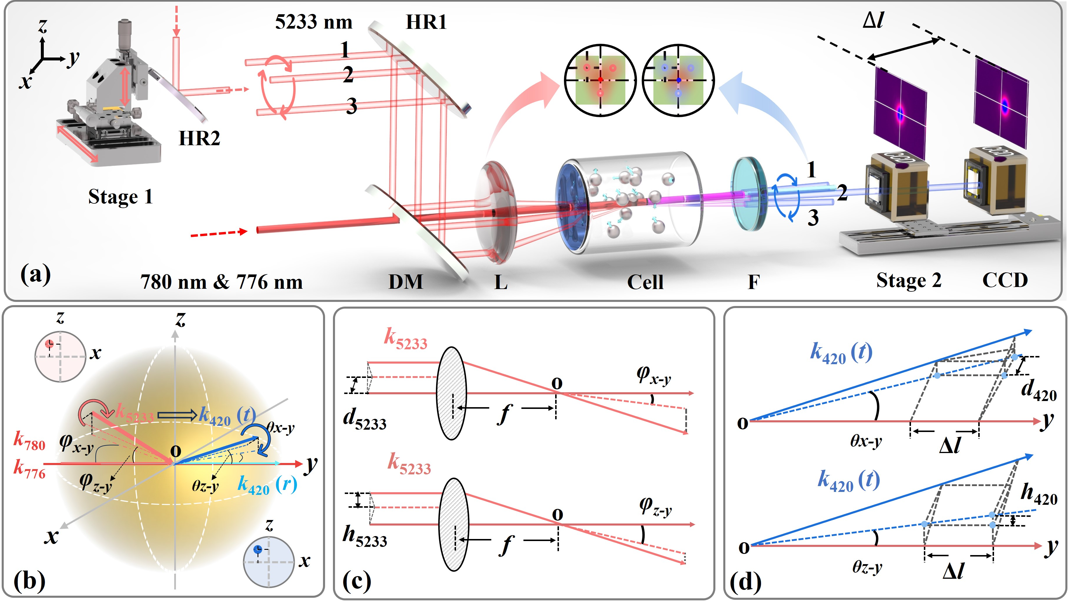
Figure 1 (a) Schematic diagram of the experimental setup; (b) Vector space distribution diagram; (c) Projection of the target beam in the x-y and z-y planes; (d) Projection of the signal beam in the x-y and z-y planes.
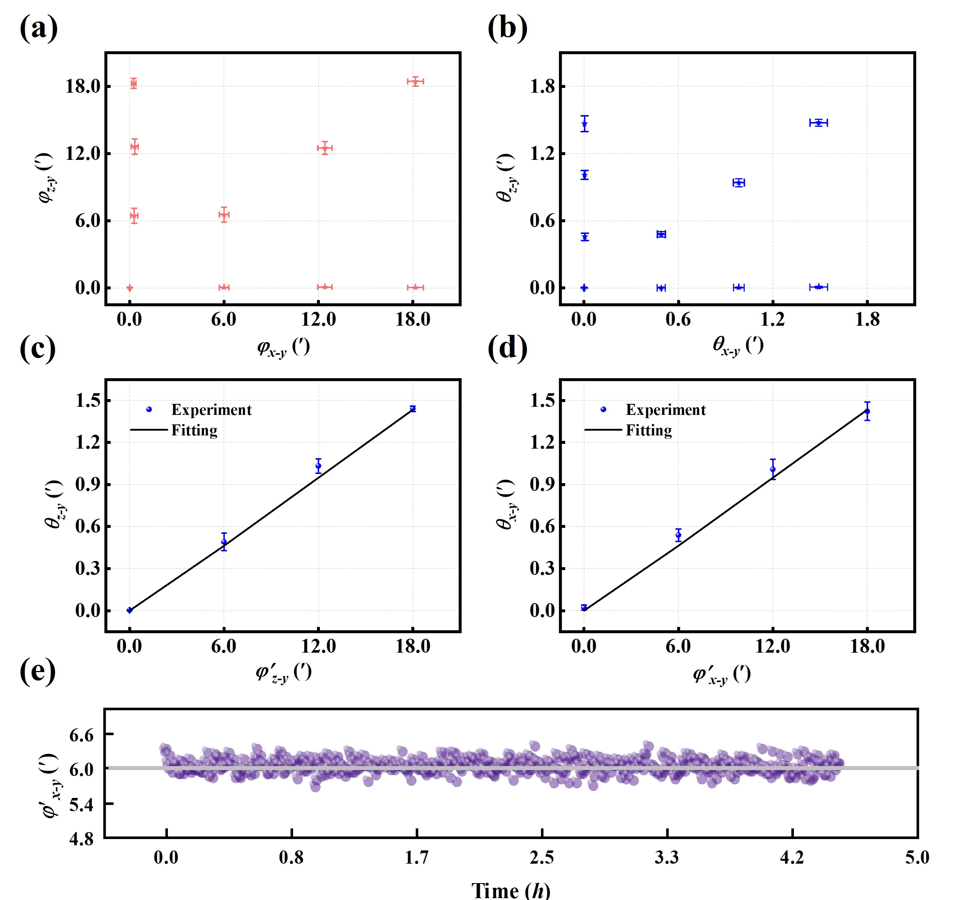
Figure 2 (a) Azimuth and elevation angles of the mid-infrared target beam; (b) Azimuth and elevation angles of the signal beam; (c) Dependency of the azimuth angles of the mid-infrared target beam and the signal beam; (d) Dependency of the elevation angles of the mid-infrared target beam and the signal beam; (e) System stability test.
This work has received support from the "Quantum Communication and Quantum Computer" major project, the National Natural Science Foundation of China, the Basic Research Program of Shanxi Province, the Scientific Research Funding Project for Returned Overseas Scholars in Shanxi Province, the Preferential Funding for Overseas Scholars' Scientific and Technological Activities in Shanxi Province in 2023, the Key Discipline Construction Fund of Shanxi Province under the "1331" Project, the National Key Laboratory of Optics Quantum Technology and Devices, as well as the Collaborative Innovation Center for Extreme Optics jointly established by the provincial and ministerial authorities.
Article address:https://doi.org/10.1021/acsphotonics.5c01683