Research1
Research on the Optical Transmission Characteristics of Electromagnetically Induced Optical Lattices
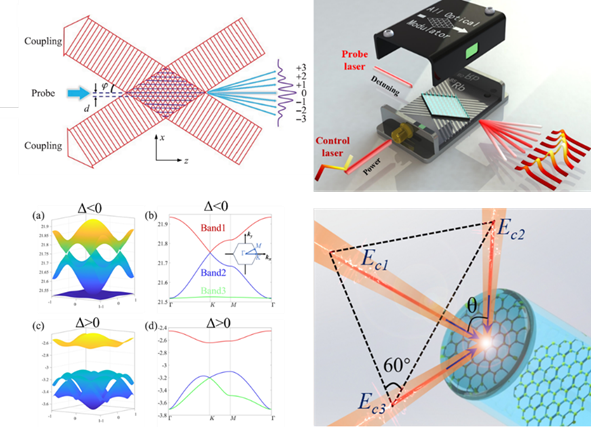 By using multi-beam interference and spatial light modulation technology, various different configurations of electromagnetic-induced optical lattices were constructed. The transmission characteristics of different types of optical fields in these lattices were systematically studied. Technologies for controlling the optical fields such as gain loss, phase modulation, and refractive index reshaping were developed. The lossless transmission, efficient conversion, and real-time dynamic control of the target optical fields were achieved. Full-optical beam splitting controllers, full-optical modulators, and other full-optical devices were designed and developed.
Research2
Microwave receiving system based on Rutherfordium atoms
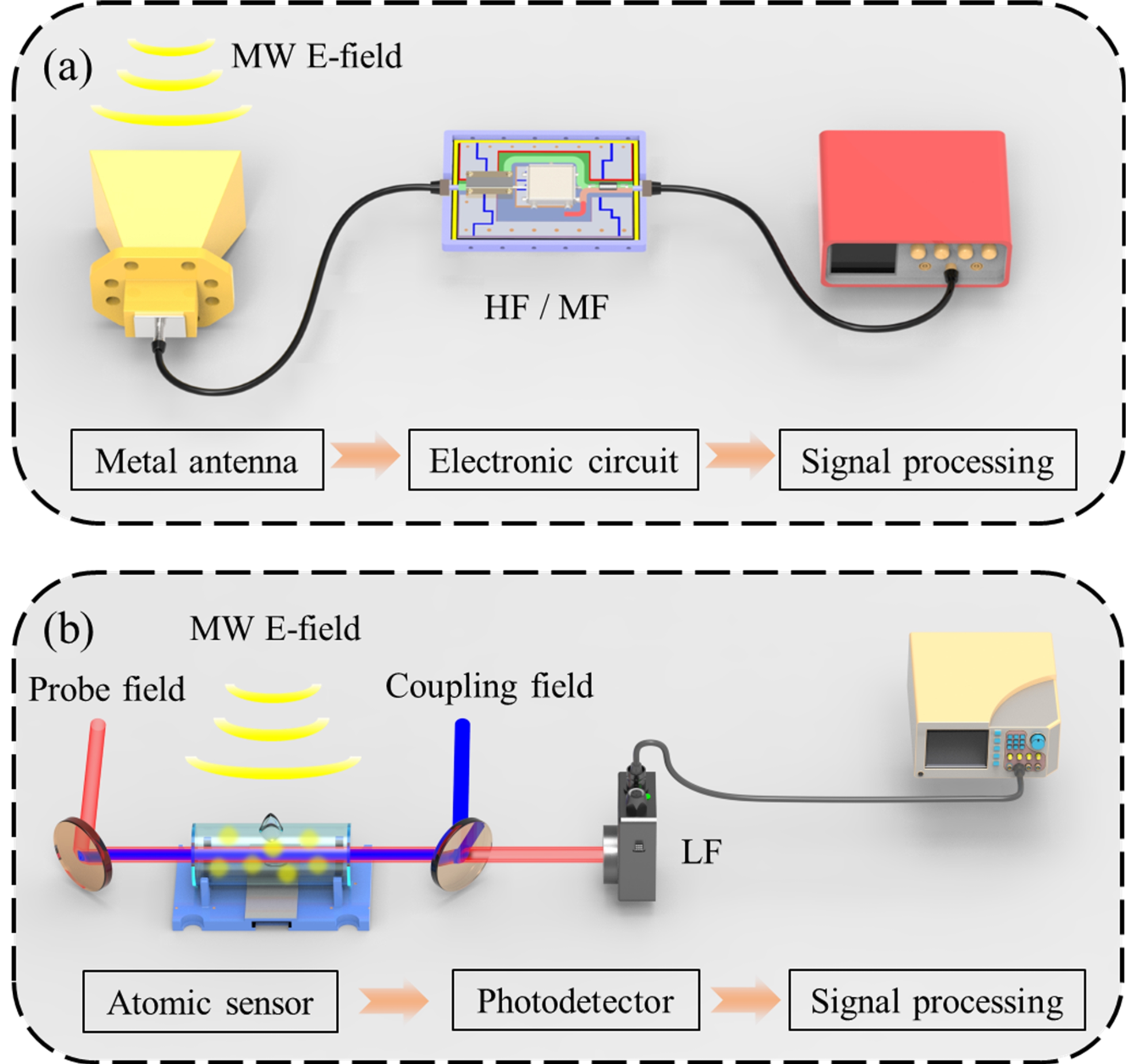 Taking advantage of the high sensitivity, wide bandwidth, high concealment and good integration of Rb atoms in microwave electric field measurements, combined with the unique characteristic that its measurement results can be traced back to the International System of Units (SI), an Rb atom platform suitable for high-precision electric field detection was experimentally constructed. By preparing a high-density Rb atom ensemble, a complete receiving link model of the atomic heterodyne microwave electric field measurement system was established. At the same time, by leveraging the editability of the spatial-field distribution, the electromagnetic field structure was finely regulated, further enhancing the detection capability and system performance of the Rb atom microwave electric field counter, providing a solid foundation for the development of quantum electromagnetic measurement technology.
Research3
Research on Nonlinear Control of Structured Light Fields
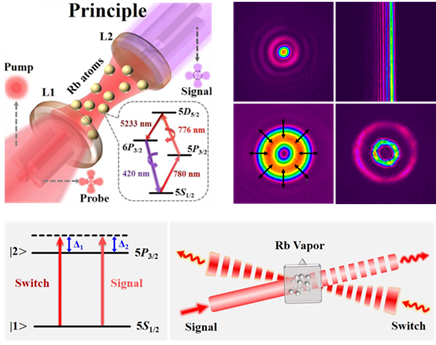 By driving the multi-wave mixing process through spatial structured light fields, efficient nonlinear frequency conversion can be achieved. At the same time, the transverse and longitudinal modes of the light field are utilized and controlled to develop multi-dimensional and multi-band optical signal processing technologies. Further, by taking advantage of multiple dimensions of the light field, nonlinear spatial modulation of parameters such as refractive index and polarization intensity of atomic media can be realized. The modes of the light field and material properties can be regulated and characterized, and efficient, rapid, and precise optical control and measurement methods can be developed.