

The research team has made significant progress in realizing a reconfigurable geometric structure in photonic graphene within a coherent atomic ensemble
Graphene is a solid material with a single-layer two-dimensional honeycomb lattice structure. Its superior optical and electrical properties have made it a highly regarded research hotspot in numerous disciplines such as physics and chemistry. Photonic graphene, also known as the honeycomb lattice, is a similar material to graphene in photonics, with its lattice structure also presenting a honeycomb-like distribution. It has broad application prospects in topological photonics. Currently, photonic graphene based on solid materials has been extensively studied. However, the lattice structure of these photonic graphene is usually non-tunable, which limits photonic graphene in research fields such as quantum information processing and all-optical networks that require tunable characteristics. Compared to solid materials, coherent atomic media are widely used in the preparation of tunable photonic crystals due to their instantaneous reconfigurable characteristics. In recent years, photonic graphene generated based on the electromagnetic-induced transparency effect of atomic media has exhibited remarkable tunable characteristics, generating more fascinating new phenomena in the research of graphene-like effects such as topological defects, spin-orbit coupling, boundary states, and angle-dependent Klein tunneling. These studies have been achieved in conventional photonic graphene, while more geometric structures of photonic graphene, such as stretchable structures, have not yet been realized in atomic media. This stretchable structure will pave the way for the study of light transmission and valley Hall effect in atomic media.
The research group recently published an article titled "Photonic graphene with reconfigurable geometric structures in coherent atomic ensembles" in Frontiers of Physics. They were the first to achieve photonic graphene with reconfigurable geometric structures in a coherent three-level rubidium atomic system, and conducted a systematic study on its tunable properties. The researchers first induced photonic graphene in a thermal atomic medium using the electromagnetic induced transparency effect and three-optical interference technology. By adjusting the spatial arrangement of the three-beam interference coupling light fields, they realized different geometric stretching structures of photonic graphene, and characterized the current geometric features of photonic graphene based on the discrete diffraction patterns of the incident detection field.
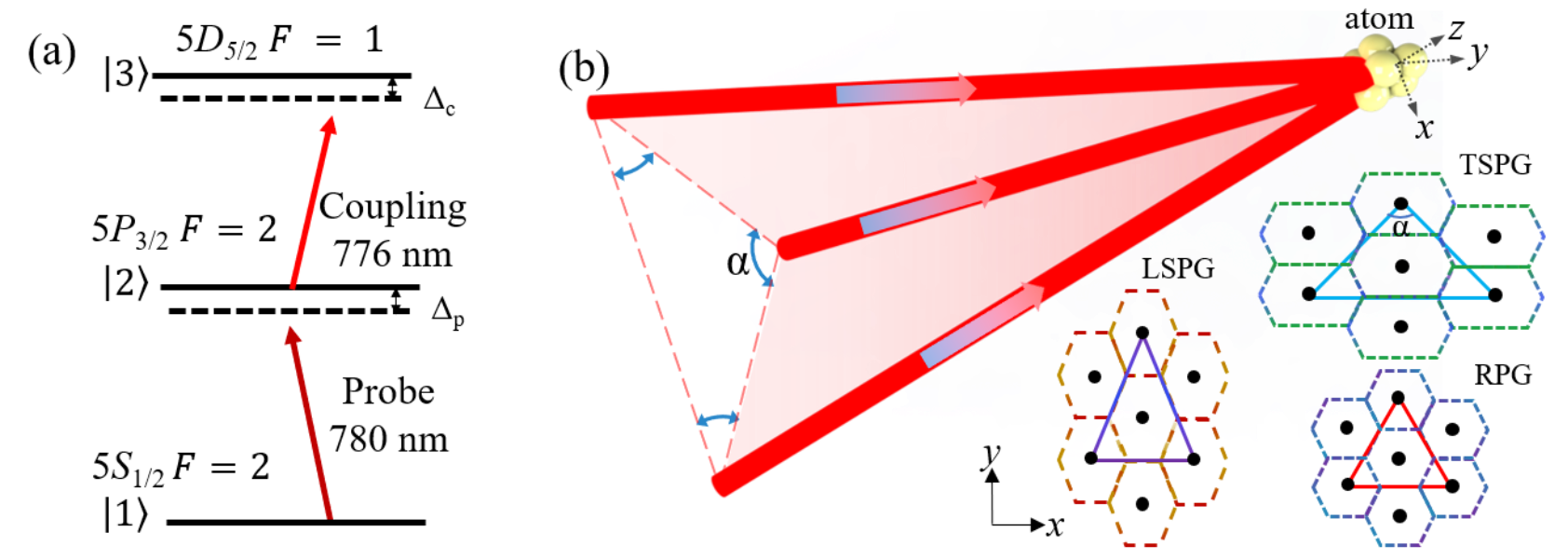
Figure 1 (a) Experimental energy level diagram; (b) Schematic diagram of stretching photonic graphene
The research team theoretically simulated the hexagonal coupled light fields corresponding to different geometric structures of photonic graphene, as well as the far-field diffraction patterns when the two-photon detuning Δ > 0 occurred. They observed experimental results that were consistent with the theory. In the conventional photonic graphene, where the spatial arrangement of the three coupled beams forms an equilateral triangle, the far-field diffraction pattern of the probe light shows a regular hexagonal distribution, and the first-order diffraction intensity is approximately equal. Based on this, by changing the spatial arrangement of the three coupled beams to form an isosceles obtuse or acute triangle distribution, photonic graphene stretched in the transverse or longitudinal direction was obtained. At the same time, in the far-field diffraction, a hexagonal distribution diffraction pattern stretched laterally or longitudinally can also be observed. The first-order diffraction intensity along the stretching direction decreases due to the increase in the lattice constant, and the greater the stretching degree, the weaker the diffraction intensity.
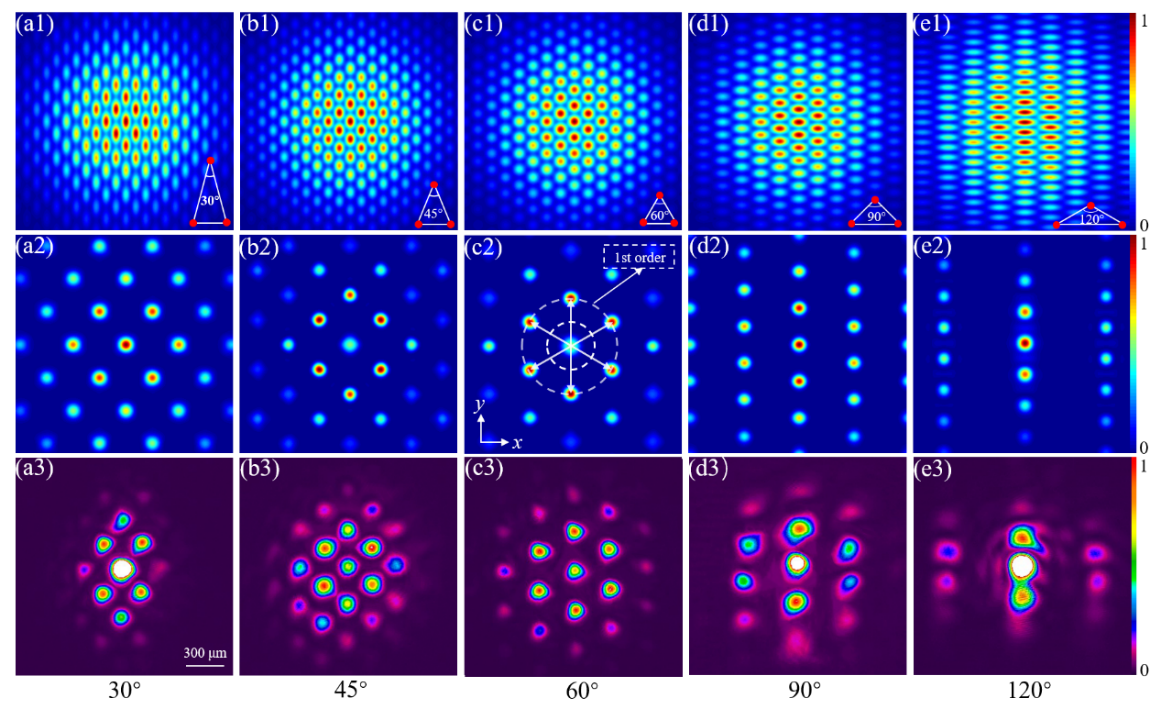
Figure 2 (a1-e1) Theoretical simulation of hexagonal coupled field. (a1) 30°, (b1) 45°, (c1) 60°, (d1) 90°, (e1) 120°. (a2-e2) Corresponding theoretical simulation far-field diffraction diagrams. (a3-e3) Far-field diffraction diagrams of the output detection beam observed experimentally.
Furthermore, various coherent control techniques based on the electromagnetic induced transparency effect can modulate the refractive index of the atomic medium that the probe light senses periodically by altering the optical field characteristics applied to the system. This allows for the modulation of the modulation depth of its lattice points. According to the findings of the research team's previous work, when the two-photon detuning Δ changes from a negative value to a positive value, the refractive index undergoes a reversal. Although its profile always presents a honeycomb lattice outline, the corresponding diffraction pattern of the probe light will exhibit an evolution from a honeycomb shape to a hexagonal shape [Opt. Express 31(7), 11335-11343 (2023)]. To better demonstrate the generation of the stretched photonic graphene, while avoiding the far-field diffraction observation errors caused by the self-defocusing effect when Δ < 0, the research team experimentally observed the near-field diffraction patterns of different geometric structures of the photonic graphene at -15 MHz and 15 MHz. The experiment found that at -15 MHz, the probe light output of the conventional photonic graphene displayed a clear honeycomb outline. By changing the spatial arrangement of the three coupled beams, the honeycomb-shaped diffraction pattern will be stretched in different directions; while at 15 MHz, the near-field diffraction changes are basically consistent with the far-field observations. This near-field diffraction phenomenon further vividly characterizes the reconfiguration process of the photonic graphene's geometric structure, increasing the credibility of the experimental conclusion. Therefore, by changing the spatial arrangement of the three interference coupled beams, photonic graphene of any stretching degree can be achieved. This photonic graphene with a reconfigurable geometric structure paves the way for further research on light transmission and valley Hall effect. Additionally, the researchers also changed the system parameters, such as the two-photon detuning and the coupling light power, to dynamically adjust the distribution of the photonic graphene lattice strength, fully demonstrating the flexible tunable characteristics of the system, providing an ideal platform for further research on quantum information processing and quantum networks in atomic systems.
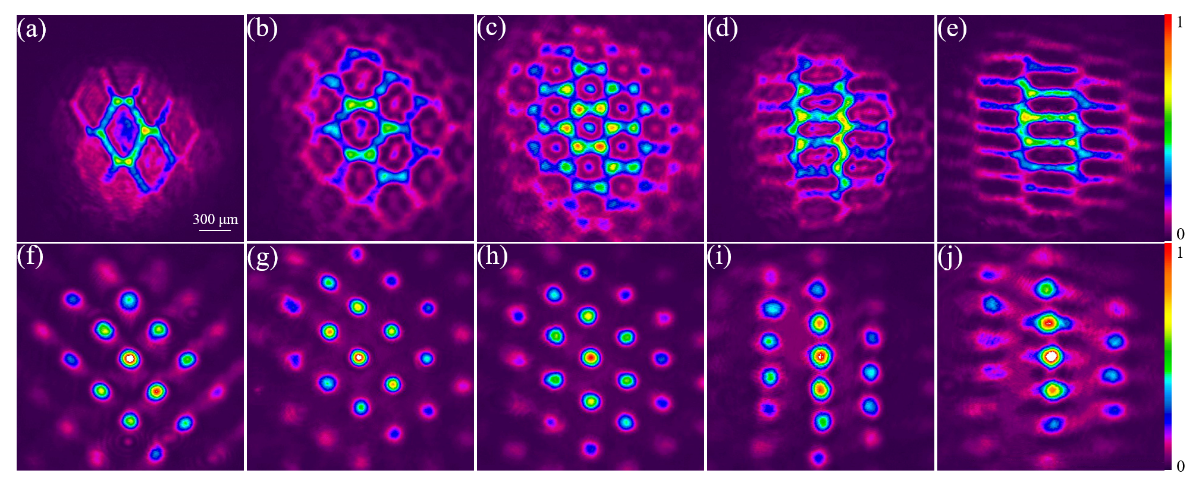
Figure 3 Near-field diffraction patterns of the output detection light beams of photonic graphene with different geometries.
Paper Address: https://doi.org/11.1007/sll14767-023-1294-2