

The research team has made significant progress in the cross-frequency band transmission study of the time-space optical Ferris wheel
Recently, the research group has made significant progress in the cross-frequency band transmission research of the spatio-temporal optical Ferris wheel. The related research results were published in the journal "Photonics Research" on October 31, 2024, under the title "Trans-spectral transfer of spatio-temporal optical Ferris wheel with nonlinear wave mixing". It was selected as the cover article and Editor's Pick (Editor's Selection) of the 11th issue of 2024. Postdoctoral researcher Wang Sandan is the first author of the paper, Professor Yuan Jinpeng and Professor Wang Lirong are the co-corresponding authors of the paper, and Professor Xiao Liantuan and Professor Jia Suotang provided important guidance for this work.
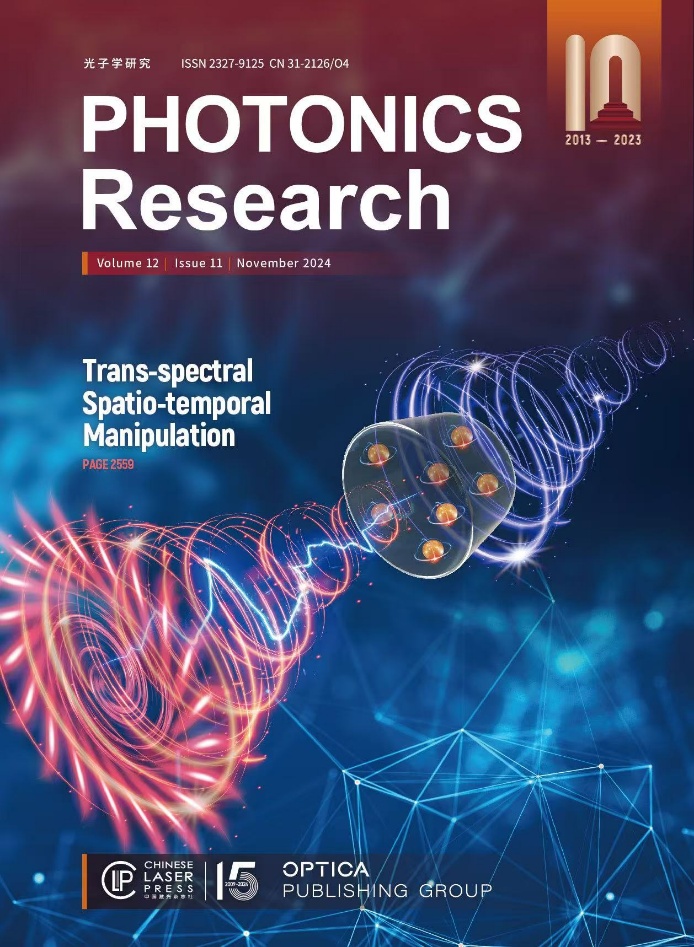
Optical field control is a technical means that precisely regulates the interaction between light waves and matter to control the optical physical properties. It has broad application prospects in the fields of optical sensing and optical communication. Traditional research on optical field control mainly focused on physical parameters such as the frequency, amplitude, phase, and polarization of light. In recent years, the spatial structure of the optical field, as another important physical dimension, has gradually attracted widespread attention. By regulating the spatial structure of the optical field, it is possible to customize the transverse plane of light in three-dimensional space, thereby generating various special structured optical fields. Further, with the integration of spatial structure and the time dimension, the spatiotemporal structured optical field, which has complex dynamic trajectories and spatiotemporal characteristics, has emerged. It has brought new technical means to precision measurement and quantum communication fields, and has promoted revolutionary progress in optical information processing.
The traditional manipulation of spatial-temporal structured light fields relies on linear optical components. However, due to the difficulties in manufacturing these components, the high requirements for materials, the low damage threshold, and the high cost, achieving efficient manipulation within the short wavelength range (300 nm ~ 470 nm) poses significant challenges. To overcome these limitations, nonlinear frequency conversion technology emerged. This technology utilizes nonlinear optical materials and through optical nonlinear effects, provides powerful tools for constructing, detecting, and manipulating light fields across different wavelengths. Alkali metal atoms, as a pure and impurity-free nonlinear medium, have the advantages of a wide tuning range, high damage threshold, and easy saturation, making them an ideal platform for studying light field control. Therefore, nonlinear frequency conversion based on atomic ensembles offers a feasible solution for manipulating spatial-temporal structured light fields across different frequency bands from visible light to the short wavelength range.
The research team achieved high-fidelity transmission of the spatial optical Ferris wheel beam through a nonlinear frequency conversion process both experimentally and theoretically. By using a rubidium atom diamond-level system, they successfully converted the spatial and temporal characteristics of the spatial optical Ferris wheel beam from the near-infrared band to the blue-violet band. The frequency conversion process of the spatial optical Ferris wheel beam in the rubidium atom medium was theoretically simulated, and the spatial intensity and phase distribution of the 420 nm spatial optical Ferris wheel were obtained. The temporal evolution of the beam was also simulated. Experimentally, by combining an optical frequency comb and an optical vortex, a spatially and temporally highly controllable spatial optical Ferris wheel beam with a high degree of structure and characteristics was prepared through pulse-pulse interference technology. The obtained spatial optical Ferris wheel detection light and another Gaussian-type pump light were simultaneously acted upon by the rubidium atoms, and the spatial optical Ferris wheel beam was transmitted from the near-infrared to the blue-violet band through the four-wave mixing process. By observing the same multi-peak intensity distribution of the input and output beams, the transfer of spatial characteristics was verified; simultaneously, by synchronizing the rotational speed and direction of the input and output beams, the successful transfer of temporal characteristics was confirmed, with a transfer accuracy of approximately 98%.
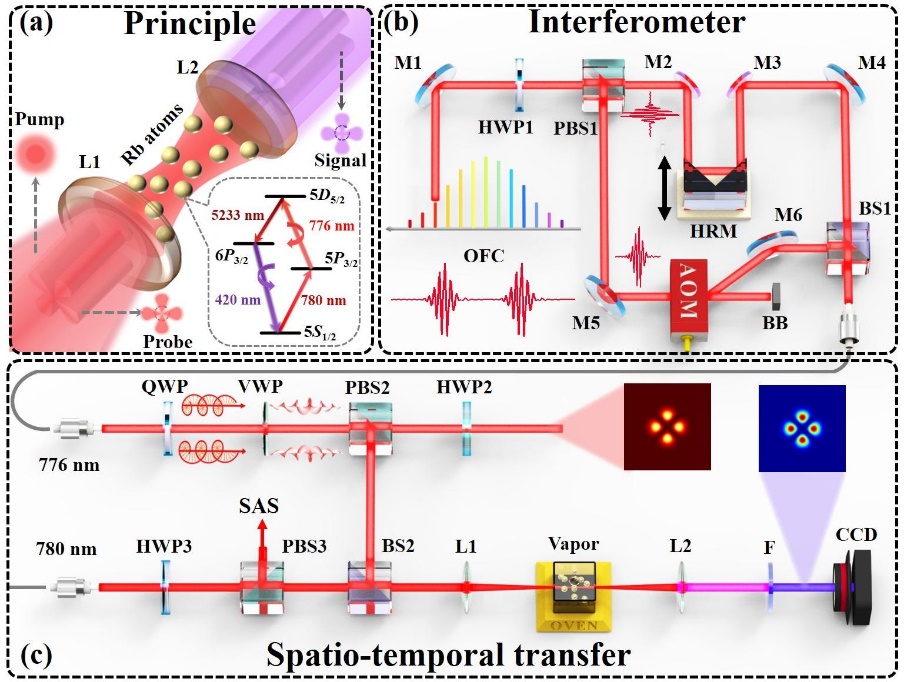
Figure 1 (a) Schematic diagram of the principle for realizing cross-band transmission of spatiotemporal optical Ferris wheel beams through nonlinear wave mixing; (b) Schematic diagram of the pulse-pulse interference experimental setup; (c) Schematic diagram of the spatiotemporal optical Ferris wheel beam transfer experimental setup.
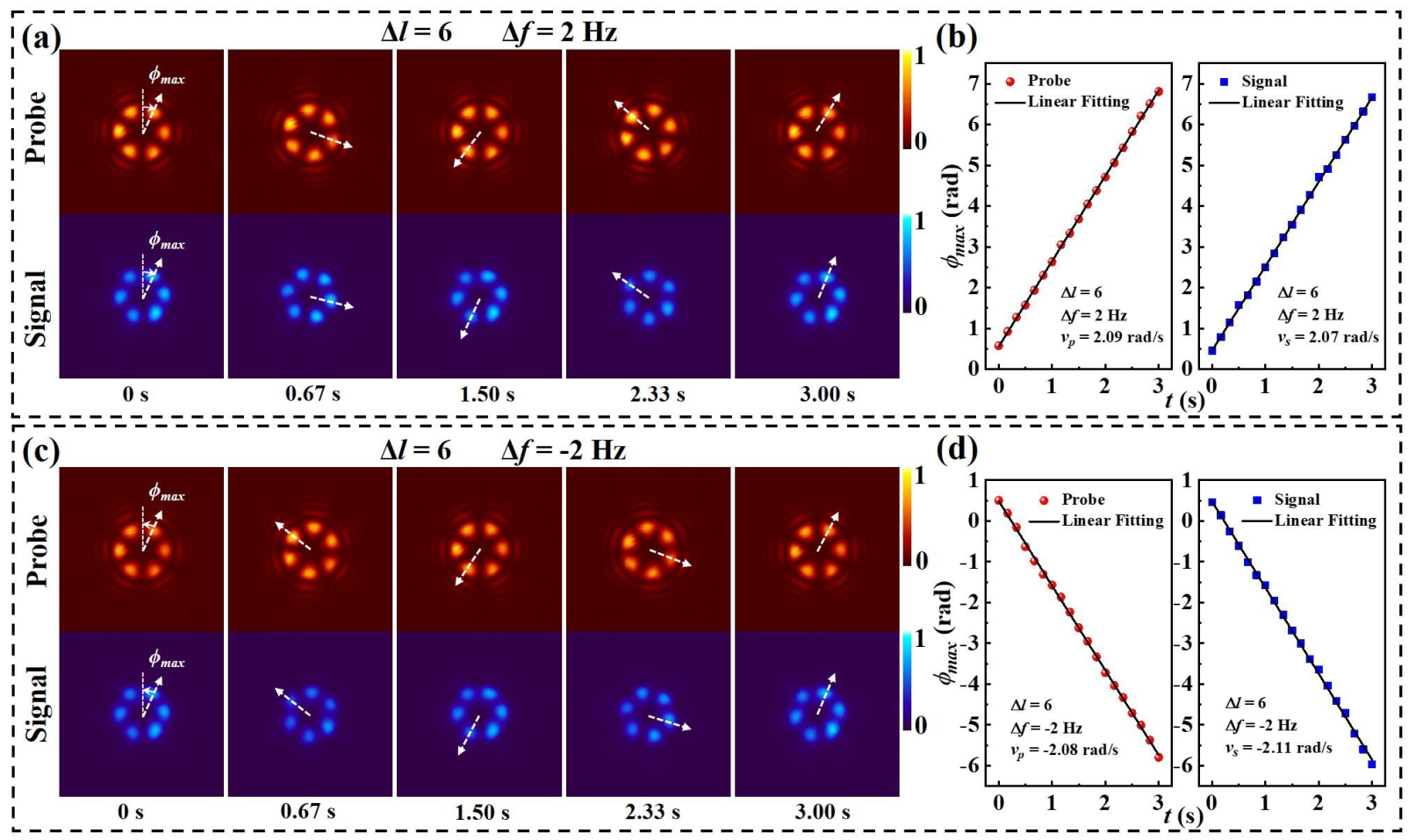
Figure 2 Experimental results of the beam transfer of the spatial optical Ferris wheel. (a) and (c) show the rotational patterns of the 776 nm detection light and the 420 nm signal light over time respectively; (c) and (d) show the changes in the azimuth angle of the maximum beam intensity over time respectively.
This work was supported by the 2030 - "Quantum Communication and Quantum Computer" major project, the National Natural Science Foundation of China, the Basic Research Program of Shanxi Province, the Scientific Research Funding Project for Returned Overseas Scholars in Shanxi Province, the Preferential Funding Project for Overseas Scholars' Scientific and Technological Activities in Shanxi Province in 2023, the National Postdoctoral Researcher Support Program, the Key Discipline Construction Fund of Shanxi Province under the "1331" Project, the National Key Laboratory of Quantum Optics and Optical Quantum Devices, and the Collaborative Innovation Center of Extreme Optics jointly established by the provincial and ministerial authorities.
Article address: https://doi.org/10.1364/PRJ.534857