

Microwave receiving system based on Rutherfordium atoms
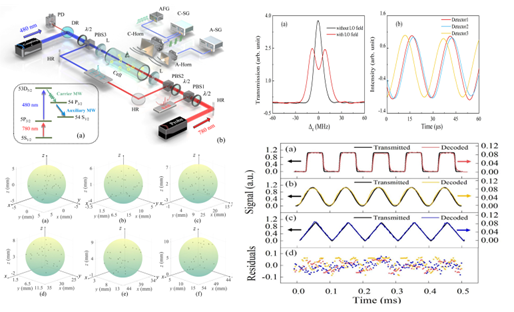
The microwave measurement system has played a significant role in enhancing human understanding of the surrounding environment and the universe. However, as the exploration of the unknown world continues to deepen, traditional microwave measurement systems based on antennas and electronic circuits are limited by physical size effects and Johnson-Nyquist thermal noise. As a result, they have difficulty meeting the current development requirements in terms of detection sensitivity and measurement accuracy. To address this challenge, the laboratory fully leveraged the unique advantages of Rydberg atoms, including extremely high electric field sensitivity, a wide working frequency band, high stealth capability, excellent integrability, and the characteristic that its measurement results can be directly traced back to the International System of Units (SI). They explored a new generation of quantum microwave measurement technologies. By preparing high-density Rydberg atomic ensembles, a receiver link model for an atomic-based superheterodyne microwave electric field measurement system was established. At the same time, by taking advantage of the programmability of the spatial-field distribution, the electromagnetic field structure was finely controlled, significantly enhancing the performance and application potential of the Rydberg atom microwave electric field counter. Currently, the research content of the laboratory covers the following directions: (1) Cavity enhancement technology based on optics and microwaves; (2) Multi-frequency and multi-state microwave information transmission mechanisms; (3) Array sensing and spatial resolution imaging technology; (4) High dynamic range electric field sensing.
n Related pictures
n References
1) A Rydberg atom-based receiver with amplitude modulation technique for the fifth-generation millimeter-wave wireless communication. IEEE antennas and wireless propagation letters, 22(10), 2580-2584 (2023).
2) Quantum sensing of microwave electric fields based on Rydberg atoms. Reports on Progress in Physics, 86(10), 106001, (2023).
3) Three-dimensional location system based on an L-shaped array of Rydberg atomic receivers. Optics Letters, 48(15), 3945-3948 (2023).
4) Large power dynamic range microwave electric field sensing in a vapor cell. Optics Express, 32(20), 35202-35211 (2024).